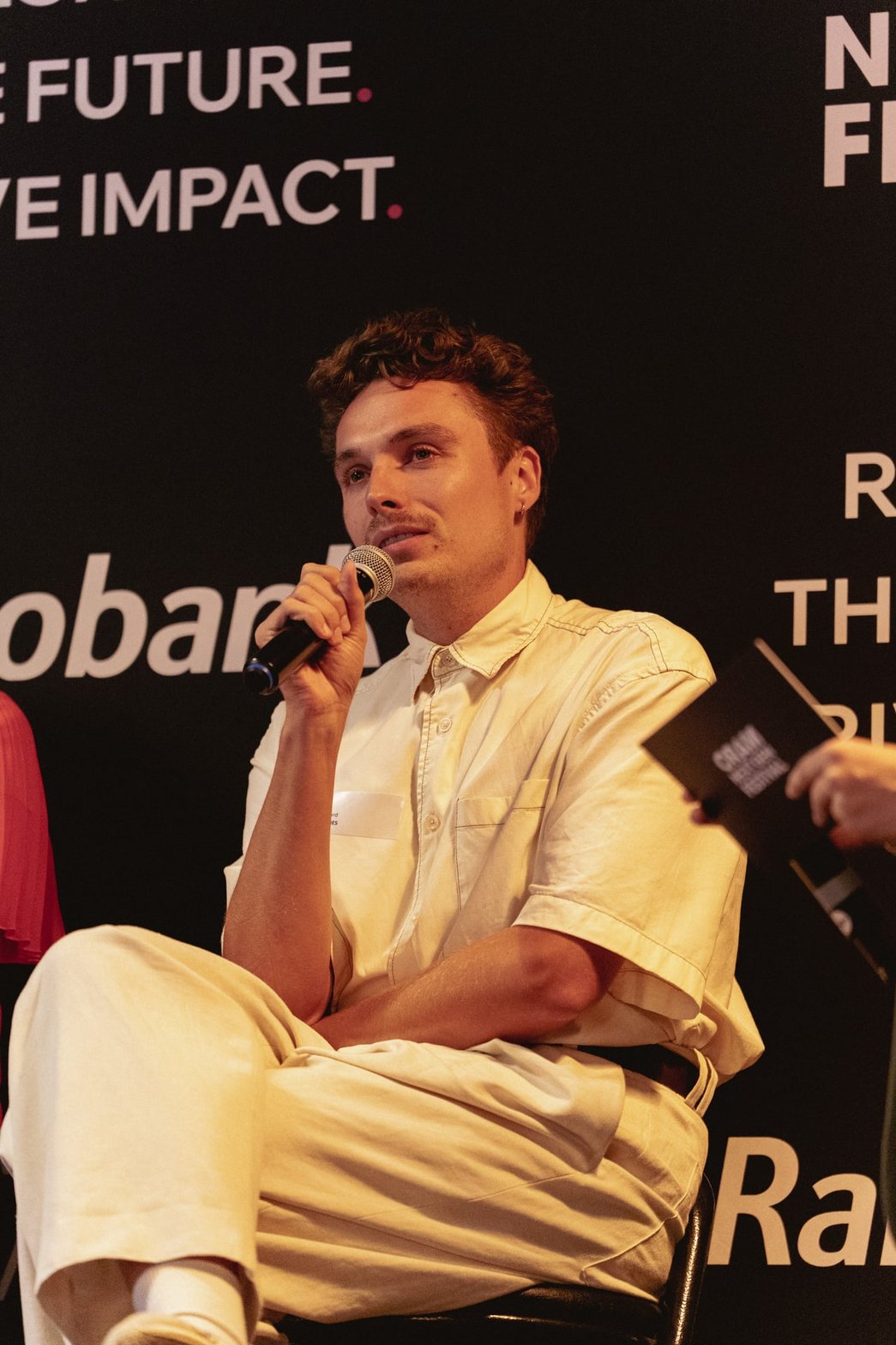
Almost everyone says they serve the common good. Almost everyone acts from self-interest. That isn't cynicism. It's rational, and it's the reason cooperation so often stalls. That premise opened a pressure-cooker session at the ORAM Next Gen Festival on 28 August. At UP Events, young professionals aged 20 to 39 from across the Amsterdam Metropolitan Area (MRA) spent an hour taking one hard regional dilemma apart.
The session was led by Abel Koentjes of the Amsterdam Economic Board's Young on Board, and he opened not with the case but with a provocation: when did you last give something up at work for someone else, not as a trade, with no guaranteed return? His argument: self-interest won't disappear, so the goal isn't to make people less selfish. It's to design the system (the forest) so that a single spark doesn't burn the whole thing down. The task that followed was pointed: don't be the lobbyist defending your organisation's position, be the architect at the table. Design the smallest possible change, whether a norm, a contract, a platform or a shared fund, that makes cooperation the rational choice, and answer two questions: who has to move first without a guarantee, and what do they get back?
And that argument was meant for exactly this audience: you are not yet captured. No twenty years of coalition history to defend, and here that is the most valuable thing you bring.
The case: datacenters in the MRA
Demand for datacenter capacity is exploding, and a disproportionate share of it lands here. The numbers make the squeeze concrete: around 200 datacenters in the Netherlands, most of them around Amsterdam; 7% of national electricity use, up from 3.3% in 2021; an average permitting time that has stretched to 4.5 years, from ten weeks in 2016; €21 billion in projected construction investment by 2031; and two MRA municipalities that have already imposed a moratorium. The grid is full, the water sector is at its limit, and, as a stakeholder map laid bare, no single party can solve it alone.
Working against the clock, participants had to produce not just an answer to the datacenter case, but a principle: one sentence that would still hold against the next scarcity conflict in the region. Two came through clearly.
Give back what you use. A reciprocity principle, kept deliberately broad so it reaches well beyond datacenters: generate what you consume, and give back whatever you take. The group ran straight into the hard question of who is actually responsible, the building's owner or its users. Their own answer was that everyone is co-responsible, because a datacenter only exists because of its users, and we all draw on that capacity. A related move: agree on a shared value everyone endorses and negotiate toward that, so no single party is maximising its own interest.
Use no more than you need. A demand-restriction principle: don't make AI the free, frictionless default. A basic search doesn't need to fire up a model; build in thresholds; don't make heavy compute free-by-default, so it isn't spent on generating recipes on a whim. The honest consequence they named themselves: more restriction means a bigger role for government. And the logic shouldn't stop at datacenters, because industry already consumes far more energy and water, so the same principle should apply there too.
What it was worth
Two recognisable, transferable principles: reciprocity and demand restriction. That was exactly the goal, something that reaches past the case in front of them. It's worth being sober about the rest. On the hardest part the groups got stuck: who gives back what, how you set a ceiling, and how you enforce any of it without pulling government into everything. That difficulty was arguably the whole point. As Abel put it, we are collectively not very practised at solving problems together, and that shared muscle is the thing worth building.
There is a direct line onward. Abel committed to translate the two rules into principles for the festival's closing panel, and to take them back to the Economic Board to make the case for them.